C’était parfait ! Tu vas devoir corriger mes erreurs plus souvent 
It was perfect! You’re going to have to correct my mistakes more often
C’était parfait ! Tu vas devoir corriger mes erreurs plus souvent
It was perfect! You’re going to have to correct my mistakes more often
Du coup, on parlait avec @Kimballet de comment les français utilisent le Verlan. J’ai fait une petite liste de mots qu’on utilise le plus souvent.
Soo we talked with Kim about how French use “Verlan”, and I made a short list of words we use the most.
“Verlan” is a very familiar and famous language that using “reverse words”. C’est très utilisé par les jeunes ou entre amis. Don’t ever use it in a work environment or you could look like a delinquent
ouf > fou (=crazy)
Ex: C’est ouf! It’s crazy! C’est un ouf! He’s crazy!
chan-mé > méchant (=wicked in a cool way)
tar-pé > pétard (can means “butt” or “weed cigarette”… depends on the conversation )
Ex: Mate-moi ce tarpé! Look at her/his butt Passe le tarpé. Give me the join
re-lou > lourd (= can mean somehting like “it sucks” or someone very annoying, most of the time used when someone is trying to flirt very badly)
Ex: J’en ai marre de mon travail, c’est relou! I’m sick of my job, it sucks Quel gros relou ce mec. What an annoying guy.
chelou > louche (=weird/strange)
cimer > Merci
teubé > Bête (= idiot. Only used for a person, not a situation or anything else.)
Ex: C’est un teubé! He’s an idiot
oim > Moi
teuf > fête (=a party. Thanks to Kim, I forgot this one, haha)
Voilaaaa  J’espère que ça pourra être utile. En tout cas, ça fera beaucoup rire les français si vous utilisez un jour ces mots là.
I hope it could be helpful. Anyway, it will make French people laugh if you ever use these words.
Cimer 
J’adore le verlan parce que mon beau-père l’utilise beaucoup.
Et je crois que le mot “verlan” c’est l’inverse du mot “l’iverse“
Thanks. I love verlan because my father-in-law uses it a lot. And I believe the word “verlan” is the inverse of the word inverse.
Exactement! Ver-lan means l’envers (à l’envers).
Some other words I thought, a bit old now but still used (in hip hop songs most of the time haha):
té-ci > cité (used for poor suburbs)
keuf > flic (a cop)
mi-fa > famille (family)
meuf > femme (woman)
keum > mec (man, in a familiar way)
qué-blo > bloqué (stuck)
aç > ça (it. You can spell it like ass)
turfu > futur
ripou > pourri (a crooked cop)
vénère > énervé (angry)
Salut! Je m’appelle Milky Way! Comment ca va?
Ça va bien ! Je suis Kim et j’habite en France mais je suis américaine
Ooh comment est la France?
Je l’adore ! Je suis en Normandie pour un mariage pour le week-end mais il fait pas très beau mais c’est mieux que la canicule.
(I love it! I’m in Normandy for a wedding for the weekend but it’s not too nice out but it’s better than the heatwave. )
J’ai un question ! Comment tu demandes quelqu’un fait une ?
This was probably incorrect, please correct me! I combined some of my grammar knowledge, I don’t know the right way to say it.
I have a question! How do you ask someone to do something? As if, Close the window, Alice .
Pour te corriger : “j’ai une question. Comment tu demandes à quelqu’un de faire quelque chose ?”
To correct you, “I have a question. How do you ask someone to do something?”
Et pour les commandes en français, tu utilise le tu ou le vous form de la verbe dans l’indicatif. Les commandes = l’impératif.
Par example:
Fermes la fenêtre, Alice ! ou Fermez la fenêtre, Alice !
Visit ce site pour plus d’infos:
And for commands in french, you use the tu (informal you singular) or vous (formal or plural you) form of the indicative (normal present) tense. Command form = the imperative. For example: Close the window, Alice (using tu if she is younger than you, or a family member or vois if she is in a position of authority, to show respect). Visit that site for more info!
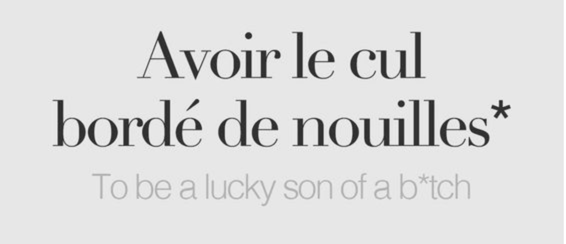
Une amie a dit ça l’autre jour et c’est très rigolo :
A friend said this the other day and it’s very funny. It literally means to have an @$$ full of noodles, but is meant as you’re lucky hahaha
Une de mes expressions préférées!
J’aime bien aussi “Faut pas pousser mémé” (Don’t push granny) but it’s probably more famous.
It’s the short form for “Faut pas pousser mémé dans les orties” (Don’t push granny in the nettles) meaning “don’t exaggerate” / “No need to go so far.”
Trop drôle !
Too funny!
J’adore Maitre Gims
ça va ! tu peux practiquer ici avec nous !
that’s ok, you can practice here with us
Bonjour à tous ,
Je m’appelle LHT et j’ai appris le français au lycée, mais je suis un peu mauvaise en ce moment.Parce que j’ai abandonné la langue pour étudier l’allemand à la place, pendant ma troisième année.
Translation below, in case my French is awful .
Hello everyone,
My name Is LHT and I learned French in high school, but I’m a little bad at it now. Because I gave up the language to study German instead, during my third year.
Oh oui bien sur, “franglish” la langue qui combine le français et l’anglais 
Oh yes of course, “Franglish” the language that combines French and English
fière/fier
Comment ça va?
Ça va ! Et toi, ça va ?